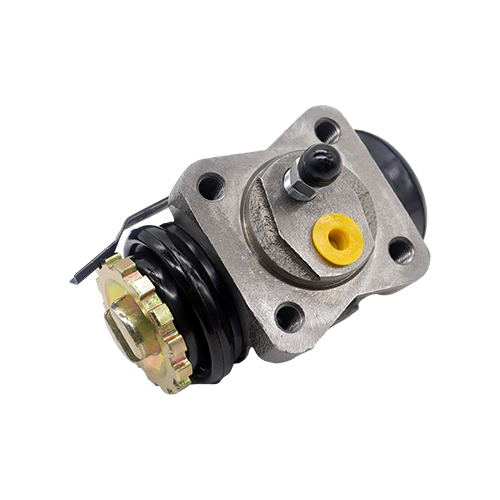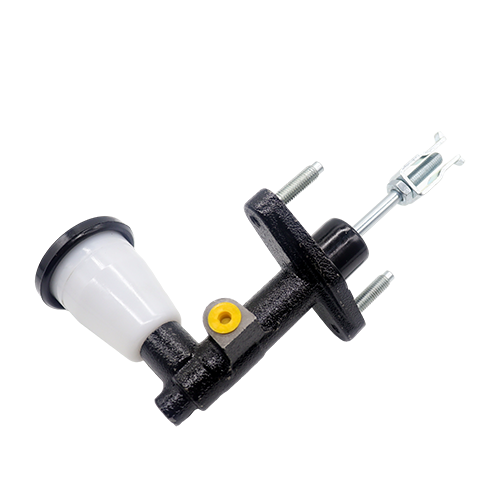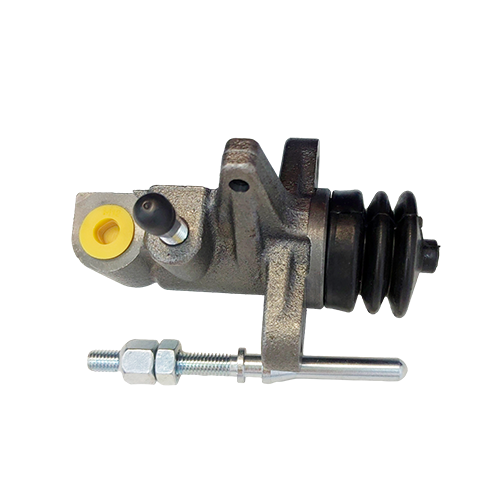
Brake wheel cylinder replacement cost is never just a number on a quotation for me. An importer sends a target price, then three months later sends a claim. The two are usually connected. The unit price is only the first line of a longer calculation, and that calculation is what this article is about.
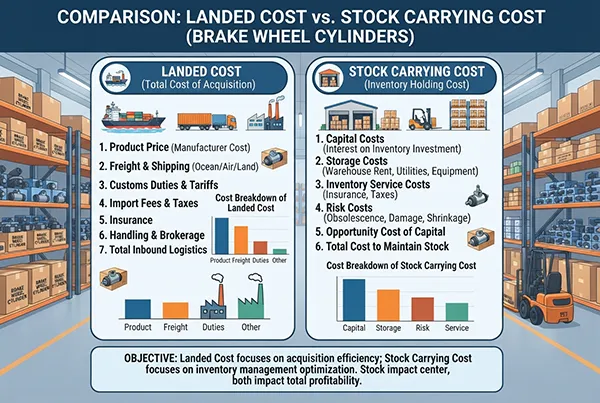
Brake wheel cylinder replacement cost, seen from an importer's side, has four layers: the landed cost of the part, the capital tied up in inventory, the cost of wrong-fitment returns and rework, and the cost of warranty claims. Two suppliers can only be compared fairly when all four layers sit on the same page.
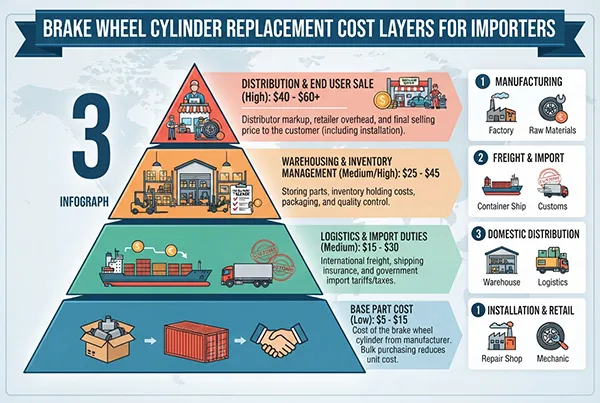
Most buyers I work with already negotiate that first layer very hard. The other three are harder to see, and they are exactly where suppliers differ. Let me take them one at a time.
Why Is Unit Price Only the First Line of Brake Wheel Cylinder Replacement Cost?
A low price feels like a win at the moment of ordering. Then the container lands, the stock sits, and one batch comes back from a workshop with a leak. The saving you negotiated can vanish in a single claim round. Low prices are not the problem. Comparing them without the rest of the equation is.
Unit price only describes what leaves the supplier's door. For an importer, brake wheel cylinder replacement cost also includes freight and duty, cash locked in unsold stock, the handling of returns and exchanges, and the time your team spends on warranty claims. All four layers can be estimated before you place the order.
The four layers, in plain terms
In our export conversations, I ask buyers to sort cost into four buckets. Most of them have never written it down before.
- Landed unit cost. Price plus freight, insurance, duty and local handling. This is the number everyone negotiates.
- Inventory carrying cost. Money tied up in stock, warehouse space, insurance, and the risk of slow-moving references. A cheaper part that only turns over slowly can cost more per year than a slightly pricier part that sells steadily.
- Wrong-fitment cost. Return freight, repacking, credit notes, and the labour of sorting a mixed batch. This is the layer that surprises importers most.
- Warranty and claim cost. Replacement parts, claim administration, and the hours your team spends on the discussion. It stays invisible until something fails.
A simple way to lay it out
| Cost layer | Visible on the quotation? | Main driver |
|---|---|---|
| Landed unit cost | Yes | Price, freight, duty |
| Inventory carrying cost | No | Order quantity, demand pattern |
| Wrong-fitment cost | No | Fitment data quality, part number discipline |
| Warranty claim cost | No | Seals, coating, batch consistency |
When a buyer tells me a competitor is cheaper, I do not argue. I ask which of the four layers they compared. Usually it is only the first one. A quotation that looks better on paper can be more expensive across a trading year, but you cannot know that without asking for fitment data, batch records and claim terms.
Do Bore Size, Material and Seals Change Brake Wheel Cylinder Replacement Cost?
Buyers often tell me that wheel cylinders for the same vehicle are basically the same. That assumption is comfortable, and it is also the most expensive one I see at the selection stage. Two cylinders can look identical outside and behave very differently after a year on the road.
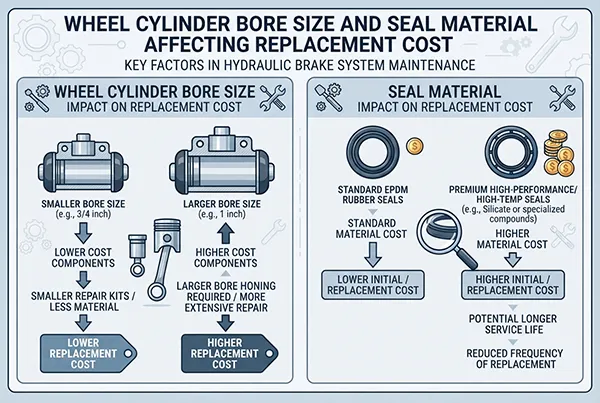
Yes. Bore size and tolerance, body material, seal compound and surface protection all affect service performance, which in turn drives returns and claims. These differences rarely appear on a quotation, because quotations list part numbers rather than specifications.
Starting with bore size and tolerance
Bore diameter is not a random number. It is matched to the brake system of a specific vehicle variant. In our production, bore tolerance is controlled to the drawing and checked per batch. A cylinder with an out-of-range bore does not fail at once. Sealing performance degrades over time, and the problem appears in the field rather than in your incoming inspection.
For a buyer, that means three practical questions:
- Are bore dimensions inspected per batch, and are records available?
- What tolerance does the supplier work to, and against which drawing?
- Will the same specification be kept across repeat orders?
Material and coating
Body and piston material vary by application, and surface protection matters just as much. In our inspection process, salt spray testing is one way we judge coating behaviour. I would treat the result as a relative indicator between samples, not as a promise about service life in every climate.
This is where money hides. A coating that performs poorly in humid coastal markets leads to pitting, then leakage, then claims. The buyer never sees it on an invoice. They see it in emails from workshops.
Seals and cups
Seal compound selection affects how the cup behaves against brake fluid and temperature cycles. Suppliers who change seal sources quietly to reduce cost usually do not announce it. If you are comparing brake wheel cylinder replacement cost between two sources, ask whether the same compound is used across batches. Batch consistency is a cost item, because inconsistency turns into unexpected claim rounds. I am not claiming that one compound always outlasts another. What I can say is that, in our experience, changes in seal source and coating process come up in claim conversations more often than changes in casting.
How Much Does Wrong Fitment Add to Brake Wheel Cylinder Replacement Cost?
A fitment error in one box feels like a small problem. It stops feeling small when it becomes one pallet, then one container, then a customer who no longer trusts your catalogue. I have watched this pattern more than once in claim conversations.
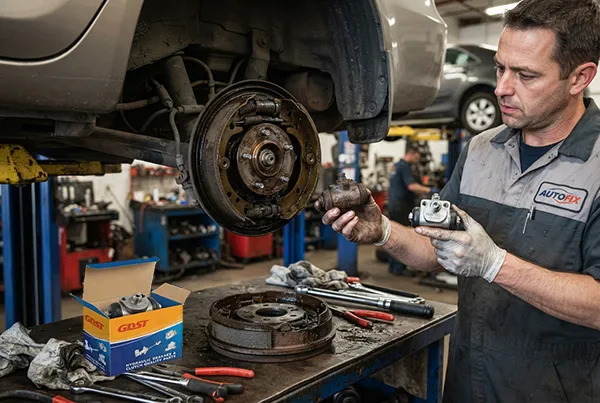
Wrong fitment is the most underestimated layer of brake wheel cylinder replacement cost. The real cost of a wrongly supplied part is not the part itself. It is the return freight, the sorting labour, the credit note, and the risk that your workshop customers order less from you next season.
Why fitment goes wrong
A single model can carry more than one brake system depending on year, market and trim. A cylinder listed for "Model X, 2010–2015" may fit only one of those variants. Multiplied across hundreds of references, that ambiguity becomes a real number.
From the supplier side, I see a few common causes:
- Catalogue data inherited from an old list and never verified.
- Interchange numbers copied between brands without checking bore and port position.
- Fitment confirmed by photo instead of by part number and variant data.
What to ask before confirming an order
- Can you supply fitment data in a structured format, not just a picture?
- Which vehicle variants does this reference cover, and which does it not cover?
- What is your process for a fitment dispute: replacement, credit, or joint review?
- Will you accept a trial order on the top references before a full container?
The hidden cost of a mixed batch
When wrong parts enter a warehouse, they rarely leave cleanly. Staff pick from a bin containing two similar references, and every pick becomes a small gamble. The cost shows up as extra handling rather than as one invoice line. This is why I keep saying that brake wheel cylinder replacement cost is better measured per year of stock movement than per piece.
Where Does Warranty Belong in Brake Wheel Cylinder Replacement Cost?
Many buyers treat warranty as a closing talking point, something to mention after the price is agreed. I think it belongs in the middle of the calculation, right beside price. A warranty is a statement about who pays when something fails.
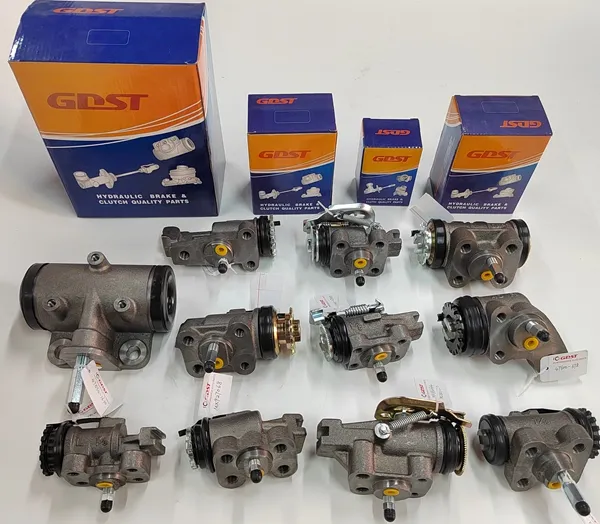
Warranty terms are part of the cost structure. A 1-year or 30,000 km commitment, combined with batch traceability and documented inspection, shows how much failure risk stays with the supplier. Without traceability, a warranty is difficult to enforce.
Reading warranty terms properly
When I review claim cases, three things separate a workable warranty from a decorative one:
- Duration and mileage limits. Ours is 1 year or 30,000 km on hydraulic parts. Both limits matter, because a taxi fleet and a weekend car reach the same mileage at very different speeds.
- Batch traceability. If a part cannot be traced back to a production batch, a claim becomes a negotiation instead of a process.
- Claim procedure. Who decides, what evidence is needed, and what turnaround time applies?
Certifications are documents, not conclusions
We produce to IATF16949 specifications, and buyers often ask about that. My honest advice is to treat any certificate as a document you verify — check the scope, the certificate number and the issuing body. A certificate describes a management system. It does not replace a sample test or a first-article inspection on your own bench.
The cost of a dispute
Even a fair claim has a cost. Your team writes emails, the customer waits, and the workshop buys elsewhere for that order. I would rather see buyers negotiate a clear claim procedure than push for a final percentage off the unit price. The procedure tends to save more money across a year, and it makes the relationship calmer.
How Should Importers Compare Suppliers Without a Shared Price List?
Different suppliers quote differently. Some price per piece, some per set, some include packaging, some do not. Comparing them by number alone is like comparing two currencies without an exchange rate. You need a common scale.
Build a comparison sheet that scores each supplier on landed cost, specification clarity, fitment data, inspection evidence, documentation and claim terms. Score the same categories for everyone, and treat unit price as one line among several rather than as the deciding line.
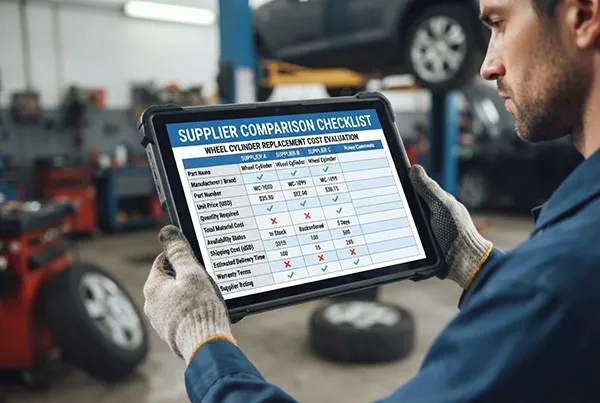
A practical scoring sheet
| Category | What to request | Why it matters |
|---|---|---|
| Specification clarity | Bore, material, seal compound, coating | Defines what you are buying |
| Inspection evidence | Batch records, salt spray, bench results | Shows process control, not promises |
| Fitment data | Structured reference data, variant notes | Reduces wrong-fitment returns |
| Documentation | Certificate scope, traceability | Makes claims enforceable |
| Claim terms | Duration, procedure, turnaround | Decides who pays when things go wrong |
| Communication | Direct factory contact, response time | Shortens problem cycles |
Questions I would ask on the first call
- Can you confirm bore and material against our drawing?
- What does your batch inspection record look like?
- How do you handle a fitment dispute in the first 60 days?
- Which markets and vehicle mixes do you already supply?
- Can we start with a trial order before a full container?
Buying direct and staying reachable
Many importers lose time through intermediaries who cannot answer technical questions. As a direct manufacturer with more than 20 years in hydraulic brake parts, we answer those questions ourselves. That does not automatically make us the right source for every reference. It does shorten the loop between a problem and an answer, and that loop carries a cost.
A simple test works well here. Send three technical questions and one claim scenario to each candidate supplier, then count the days until you get a clear answer. Response time is part of brake wheel cylinder replacement cost, whether it appears on an invoice or not. After that, verify the answers with a small trial order before committing volume.
Frequently Asked Questions
Is brake wheel cylinder replacement cost mostly labour or mostly parts?
For the end customer, workshop labour usually takes a large share of the bill. For an importer, the picture is different. Your cost is dominated by landed price, stock movement, wrong-fitment handling and warranty claims. That is why importers should compare suppliers on process rather than on repair-shop pricing.
Does a cheaper wheel cylinder always cost more in the long run?
No, and I would not claim that. Sometimes a lower-priced supplier performs well. The point is that you cannot know from the price alone. Check bore control, seal compound, coating and claim terms, then test with a small order before committing a container.
How can I reduce wrong-fitment returns?
Use structured fitment data instead of photos, confirm references against vehicle variants and year ranges, and start with trial quantities on new references. Sorting a mixed batch costs far more than a slower first order, so patience at the selection stage is usually the cheaper route.
Does a warranty replace the need for incoming inspection?
No. A warranty protects you after a failure, while inspection helps prevent that failure from reaching your warehouse. Treat certifications and warranty documents as items to verify, and keep your own sample checks on incoming batches as a second layer of protection.
Conclusion
Brake wheel cylinder replacement cost is a four-layer calculation, not a single number. Landed price is the easy part. Inventory carrying cost, wrong-fitment handling and warranty claims decide which supplier is genuinely cheaper across a year of trading. Compare bore control, seals, coating, fitment data and claim terms before you compare the last few percent of unit price, then verify everything with a small trial order. If you would like that comparison done directly with a manufacturer, send GDST Auto Parts your reference list and vehicle mix. We will confirm specifications, explain our inspection approach, and quote against the same criteria you use.