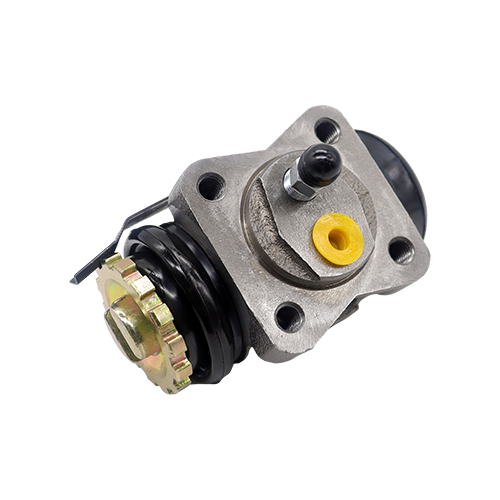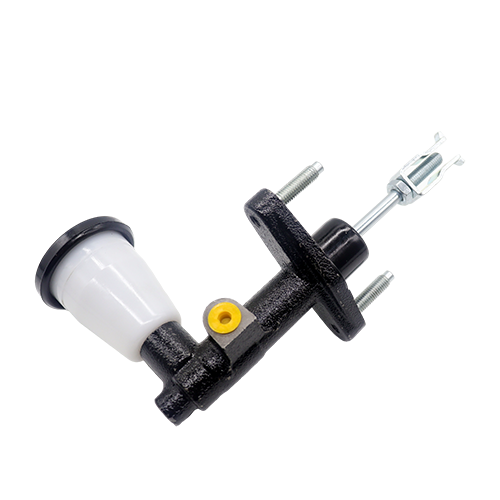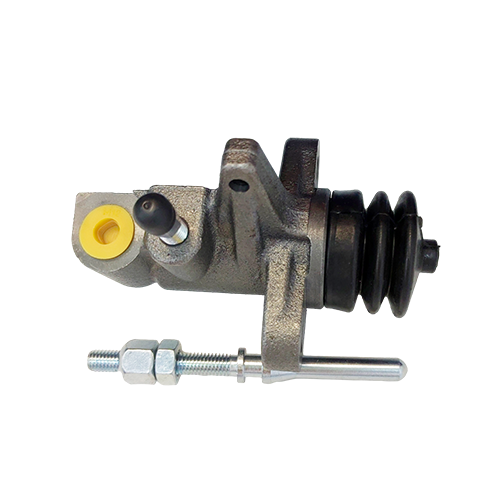
Sourcing from China feels risky when you don't know what to look for. One wrong supplier decision can mean months of customer complaints, product returns, and lost market credibility1.
The short answer: stop searching for the "best" manufacturer and start searching for the right fit. The right clutch master cylinder manufacturer is one whose quality systems, production flexibility, and export experience match your specific business model and target market.

Most buyers I speak with come in with a simple question: "Who is the best clutch master cylinder manufacturer in China?" That question sounds reasonable. But it leads buyers in the wrong direction. A high-volume importer in Southeast Asia has completely different needs from a private label brand owner building distribution in South America. The right manufacturer for one is not automatically right for the other. What I want to do in this article is walk you through how to evaluate a manufacturer properly, so you can make a decision you won't regret six months into the relationship.
Why Is "Best Manufacturer" the Wrong Question to Ask?
First-time importers almost always ask this. It seems like the most logical starting point.
But "best" means nothing without context. A better set of questions is: best for which price tier, best for which vehicle market, and best for which business model?2 These three questions will narrow your search faster than any supplier ranking list ever will.
The problem with searching for "best" is that it assumes all buyers have the same needs. They don't. Let me break this down into three dimensions that actually matter.
Which Price Tier Are You Targeting?
| Buyer Type | Price Priority | Quality Expectation |
|---|---|---|
| High-volume importer | Lowest unit cost | Acceptable field failure rate |
| Regional distributor | Competitive with margin room | Low warranty claim rate |
| Private label brand | Moderate, brand-driven | Consistent, premium appearance |
If your customers are price-sensitive fleet operators, your supplier calculus is different from a buyer who sells to independent workshops that demand reliable performance. Knowing your price tier helps you filter out factories that are either too expensive or too cheap for your market.
Which Vehicle Market Are You Serving?
Clutch master cylinders are not universal. A factory that covers Japanese domestic market vehicles very well may have thin coverage for European platforms. Before you commit to a supplier, ask them directly: what percentage of your SKUs cover Japanese vehicles versus Korean, European, and American? A good supplier should be able to show you a coverage list and cross-reference it against your own sales data. At GDST, I work with buyers across all four vehicle segments, but the first thing I ask a new inquiry is: what is your current top-selling vehicle coverage? That one question saves weeks of wasted sampling.
Which Business Model Do You Operate?
This is the question most buyers skip, and it is the most important one. Are you an importer who buys in bulk and resells under the factory's generic brand? Are you a distributor who needs consistent supply across a wide SKU range? Or are you a brand owner who needs custom packaging, logo printing, and a factory that can support your brand identity? Each model requires a different type of supplier relationship. A factory with no OEM or private label experience will not serve a brand owner well, even if their product quality is fine.
What Does Production Consistency Actually Look Like?
Low price is easy to find. A factory that delivers the same quality in shipment number one and shipment number fifteen is much harder to find.
Production consistency comes from a factory's quality control system, not from its marketing claims. The two most reliable signals are whether the factory performs 100% finished product inspection3 and whether CNC machining is a core controlled process with documented tolerance standards4.
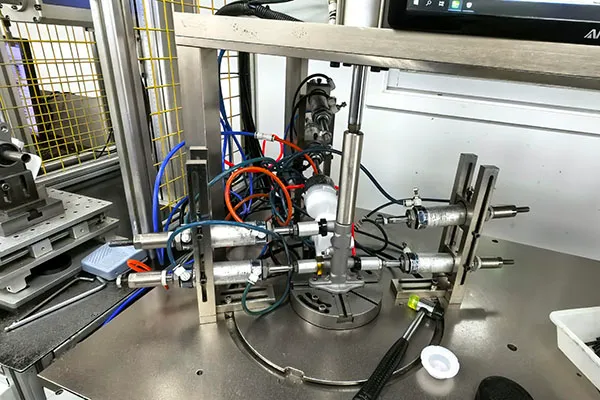
I have spoken with buyers who switched suppliers after their third shipment showed a spike in leakage complaints. In almost every case, the root cause was not a sudden change in design. It was an accumulation of small process deviations that were never caught because the factory relied on sample-based inspection rather than 100% testing.
Understanding Why CNC Machining Matters for Your Business
The clutch master cylinder is a hydraulic component. Its internal bore must meet very tight dimensional tolerances.5 If the bore is even slightly out of specification, the rubber seals will not create a proper hydraulic seal. The result is leakage, insufficient clutch pressure, or premature seal wear.
| Process Variable | If Controlled Well | If Poorly Controlled |
|---|---|---|
| Bore diameter tolerance | Consistent hydraulic seal | Leakage, customer returns |
| Surface roughness | Long seal life | Early seal failure |
| Piston fit | Smooth clutch pedal feel | Sticking or inconsistent engagement |
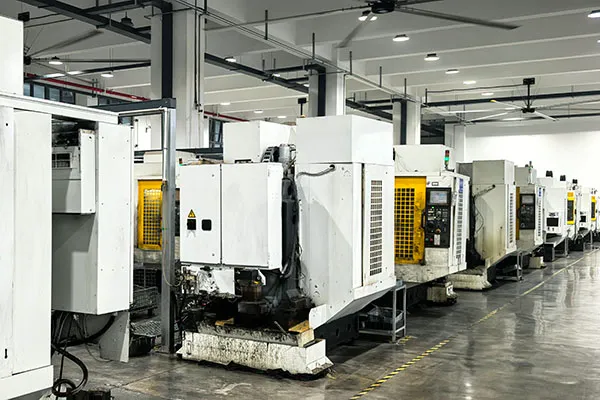
This is why CNC machining is the most critical step in the entire manufacturing process. A factory that operates CNC machining centers with online inspection systems is a factory that treats dimensional accuracy as a non-negotiable standard. When I show new buyers around our facility, this is always the first stop. The machines are the visible proof of quality commitment.
What Does a Real Quality Control System Include?
Many factories claim to have quality control. The question is what that actually means in practice.
A credible quality system covers four distinct stages.6 First, incoming material inspection, where raw materials are verified against composition standards before any production begins. Second, in-process inspection, where housing dimensions, surface finish, and machining accuracy are checked during production. Third, performance testing, including hydraulic pressure testing, leakage testing, and high and low temperature cycling. Fourth, final inspection of 100% of finished units before packaging. If a factory cannot describe each of these four stages clearly, that is a warning sign. At GDST, we run 100% housing inspection and 100% finished product inspection as standard practice. These are not premium add-ons. They are the baseline.
What Partnership Capabilities Should You Look For Beyond the Product?
A one-time purchase only needs a reliable product. A long-term supply partnership needs much more than that.
The three partnership capabilities that matter most for international buyers are flexible minimum order quantities for market testing7, mature OEM and private label support for brand development, and proven export experience in your specific regional market8.
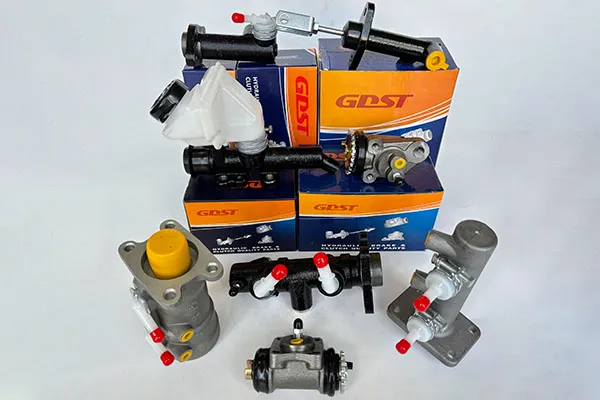
I regularly speak with buyers who are entering a new vehicle segment or launching a new brand. Their biggest fear is not product quality. It is inventory risk. They cannot afford to commit to large quantities until they know the product sells in their market. A supplier that forces a high minimum order quantity onto a market-testing buyer is not a partner. It is a vendor.
Why Flexible MOQ Is a Risk Management Tool
A factory that supports small trial orders is telling you something important about how it operates. It means the factory has a broad enough product range and production planning discipline to accommodate mixed, smaller runs without disrupting its core output. For a buyer launching a new product line in a new geography, a small initial order is not a sign of weakness. It is smart procurement. You test the product in the field, you test the supplier's service responsiveness, and you test the delivery reliability before scaling up.
Why OEM and Private Label Capability Defines Long-Term Value
If you are building a brand, your supplier is part of your brand infrastructure. A factory that only ships generic product in plain brown boxes is not useful to you. You need a supplier that can print your logo on the product or packaging, produce custom poly bags and inner boxes in your brand colors, and manage carton labeling to your specifications.
| Branding Need | What to Ask the Supplier |
|---|---|
| Logo on product | Can you do laser logo printing on the cylinder body? |
| Custom outer packaging | Can you produce cartons with my brand design? |
| MOQ for private label | What is the minimum quantity for customized packaging? |
At GDST, we support laser logo printing, customized poly bags, inner boxes, and cartons. We handle this as a standard service, not as a special project. For brand owners, this removes a major operational burden from the sourcing process.
Why Regional Export Experience Reduces Your Risk
A factory that has never shipped to your target market will make mistakes that an experienced exporter has already learned to avoid. These mistakes include incorrect documentation for customs clearance, packaging that does not survive long sea transit, and unfamiliarity with the vehicle coverage priorities of your specific market.
Southeast Asia, South America, the Middle East, and Africa each have distinct vehicle parc characteristics.9 The dominant vehicle brands in Thailand are different from those in Brazil or Nigeria. A supplier with real export history in your region will already have SKUs mapped to the vehicles that actually sell there. This is not a minor convenience. It directly affects how quickly you can build a working product catalog for your market.
How Do You Verify a Supplier's Claims Before You Commit?
Every factory will tell you their quality is good. Here is how to check that for yourself.
A practical verification process includes four steps: request the ISO 9001 certificate and check the issue and expiry dates10, ask about the warranty claim procedure in writing, request third-party test reports for the specific product you plan to purchase, and place a small trial order to evaluate both product quality and service responsiveness before scaling.
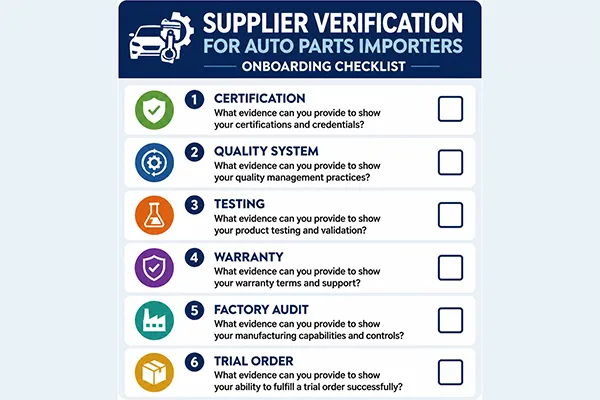
A common mistake first-time importers make is treating the initial sales conversation as a sufficient vetting process. The sales team at any factory will present the best possible picture. Your job is to go one level deeper and ask for documentation and evidence, not just assurances.
A Practical Verification Checklist
Here is a simple framework I recommend to buyers who ask me how to vet a new supplier.
| Verification Step | What to Ask or Request | What to Look For |
|---|---|---|
| Certification | ISO 9001 certificate | Valid dates, issuing body name |
| Quality system | Describe your inspection process | 4-stage system as described above |
| Testing | Third-party test reports | Hydraulic pressure, leakage, durability |
| Warranty | What is your warranty claim procedure? | Clear process, reasonable response time |
| Factory audit | Can I arrange a factory visit or video audit? | Willingness to show real production |
| Trial order | Minimum order for first shipment | Flexibility signals partnership intent |
The trial order step is the most important one. Product quality is only one variable. You are also testing lead time accuracy, packaging condition on arrival, documentation accuracy, and the responsiveness of your contact when something needs to be corrected. All of these factors will repeat in every future shipment. A trial order is the cheapest way to get real data on all of them.11
What Common Failure Modes Tell You About a Factory's Process Discipline
An experienced factory will be able to explain its own failure modes honestly. Ask your potential supplier: what are the most common failure causes for clutch master cylinders, and how does your production process address them?
The three most common failure modes are leakage, insufficient hydraulic pressure, and reduced service life.12 Each one has known root causes.
| Failure Mode | Root Cause | Process Control That Prevents It |
|---|---|---|
| Leakage | Damaged seals, poor bore machining | Surface finish control, seal material standard |
| Insufficient pressure | Seal wear, piston damage, assembly defects | Assembly line control, 100% pressure testing |
| Short service life | Inferior materials, low machining accuracy | Material verification, CNC tolerance standards |
A supplier who can answer these questions with specific process references is showing you real manufacturing knowledge. A supplier who responds with vague reassurances about quality should be treated with caution.
Conclusion
Choosing a clutch master cylinder manufacturer in China is a risk management exercise. Focus on quality systems, production consistency, regional experience, and partnership flexibility, and you will find the right fit.
"[PDF] Supplier Selection and Assessment: Their Impact on Business ...", https://digitalcommons.usu.edu/cgi/viewcontent.cgi?article=1270&context=manage_facpub. Research in supply chain management and the cost of poor quality (COPQ) demonstrates a clear link between supplier performance and business outcomes, where failures in supplier quality can lead to increased warranty claims, product returns, and erosion of market credibility. Evidence role: general_support; source type: paper. Supports: That poor supplier quality leads to significant downstream costs, including product returns and damage to a company's reputation.. ↩
"Assessing the Best Supplier Selection Criteria in Supply Chain ...", https://pmc.ncbi.nlm.nih.gov/articles/PMC9102987/. Strategic sourcing principles emphasize that supplier evaluation should move beyond simple cost analysis to a multi-criteria approach, often including alignment with the buyer's target market segment, quality tier, and operational model. Evidence role: general_support; source type: education. Supports: That effective supplier selection involves segmenting potential partners based on criteria that align with the buyer's specific market and business strategy.. ↩
"Zero Defects - Wikipedia", https://en.wikipedia.org/wiki/Zero_Defects. In quality management, 100% inspection is a strategy employed to prevent the shipment of non-conforming units by examining every item produced. It is often used for critical characteristics where the consequence of failure is high, though modern quality theory also emphasizes building quality into the process itself to reduce reliance on inspection. Evidence role: mechanism; source type: paper. Supports: That 100% inspection is a method used to ensure that no defective products are shipped, particularly for critical components.. Scope note: While it can catch defects, 100% inspection may not be as effective as robust process controls at preventing defects from occurring in the first place and can be subject to human error. ↩
"What is CNC Machining? | Goodwin University", https://www.goodwin.edu/enews/what-is-cnc/. Manufacturing engineering literature establishes that for precision components, implementing process controls and maintaining documented tolerance standards for CNC machining operations are fundamental to achieving dimensional accuracy and repeatability, which are key determinants of product consistency and performance. Evidence role: mechanism; source type: paper. Supports: That tightly controlling the CNC machining process is critical for achieving consistent quality in precision components.. ↩
"[PDF] GEOMETRIC DIMENSIONING & TOLERANCING", https://faculty-web.msoe.edu/damm/ME_491/Week%207%20Geometric%20Dimenisoning%20and%20Tolerancing%20by%20Olaf%20Pippel%20of%20HYDAC.pdf. Fluid power and engineering design textbooks explain that the internal bore of a hydraulic cylinder requires tight control over dimensional and geometric tolerances (such as cylindricity and surface finish) to ensure a reliable seal with the piston, prevent fluid leakage, and guarantee smooth operation. Evidence role: mechanism; source type: education. Supports: That the internal bore of a hydraulic cylinder, such as a clutch master cylinder, requires high precision to ensure proper function.. Scope note: Specific tolerance values are typically proprietary to the manufacturer or defined by automotive standards for a given application. ↩
"IATF 16949 - Wikipedia", https://en.wikipedia.org/wiki/IATF_16949. International quality management standards like ISO 9001 require organizations to implement controls throughout the production process, including verification of incoming materials, in-process monitoring and measurement, and final inspection and testing to verify that product requirements have been met. Evidence role: definition; source type: institution. Supports: That a comprehensive quality system in manufacturing involves checks at multiple stages of production.. ↩
"Minimum Order Quantity (MOQ): Formula, Tips, & Benefits", https://www.netsuite.com/portal/resource/articles/inventory-management/minimum-order-quantity-moq.shtml. Supply chain management research indicates that high minimum order quantities imposed by suppliers increase inventory risk for buyers, whereas flexible MOQs allow for smaller test orders, reducing financial exposure and enabling more agile responses to market feedback. Evidence role: general_support; source type: paper. Supports: That flexible MOQs from suppliers can serve as a strategic tool for buyers to manage risk when entering new markets or launching products.. ↩
"Common Export Documents - International Trade Administration", https://www.trade.gov/common-export-documents. Guides from international trade administrations and logistics experts highlight that navigating region-specific customs regulations, documentation requirements, and logistics challenges is critical for successful exporting. Suppliers with experience in a target market are less likely to make costly errors. Evidence role: general_support; source type: government. Supports: That a supplier's experience with a specific export market reduces the likelihood of logistical and compliance-related problems.. ↩
"List of countries and territories by motor vehicles per capita - Wikipedia", https://en.wikipedia.org/wiki/List_of_countries_and_territories_by_motor_vehicles_per_capita. Automotive industry market analysis confirms that vehicle parcs differ substantially by region in terms of brand distribution, vehicle age, and model popularity, driven by local economic conditions, consumer preferences, and regulatory environments. Evidence role: statistic; source type: research. Supports: That the composition of the vehicle fleet (vehicle parc) varies significantly across different continents and regions.. Scope note: Vehicle parc data is dynamic and specific statistics require sourcing from recent market reports. ↩
"ISO 9001:2015 - Quality management systems — Requirements", https://www.iso.org/standard/62085.html. The International Organization for Standardization (ISO) defines ISO 9001 as the international standard for a quality management system (QMS). Certification indicates that an organization has implemented a system to consistently provide products and services that meet customer and regulatory requirements. Evidence role: definition; source type: institution. Supports: That ISO 9001 is a globally recognized standard for quality management systems.. Scope note: Certification confirms the existence of a QMS but does not, by itself, guarantee the quality of any specific product. ↩
"[PDF] Supplier Qualification Program", https://frederick.cancer.gov/sites/default/files/2022-04/Supplier_Qualification_Program_0.pdf. Procurement and supply chain management best practices include the use of trial or pilot orders as a final validation step. This allows a buyer to assess not only product quality but also the supplier's performance in logistics, communication, and documentation before committing to larger volumes. Evidence role: general_support; source type: education. Supports: That a trial order is a practical and effective step in the supplier validation process.. Scope note: While effective, a trial order may not reveal all potential long-term issues, such as consistency across very large production runs. ↩
"Design for reliability of automotive systems; case study of dry friction ...", https://www.academia.edu/83172794/Design_for_reliability_of_automotive_systems_case_study_of_dry_friction_clutch. Automotive engineering literature and failure mode and effects analysis (FMEA) for hydraulic clutch systems identify fluid leakage (due to seal failure), loss of hydraulic pressure, and reduced operational life (due to material fatigue or wear) as principal failure mechanisms. Evidence role: expert_consensus; source type: paper. Supports: That leakage, pressure loss, and premature wear are primary failure modes for clutch master cylinders.. Scope note: The relative frequency of these failure modes can vary based on the specific design, material quality, and operating conditions. ↩