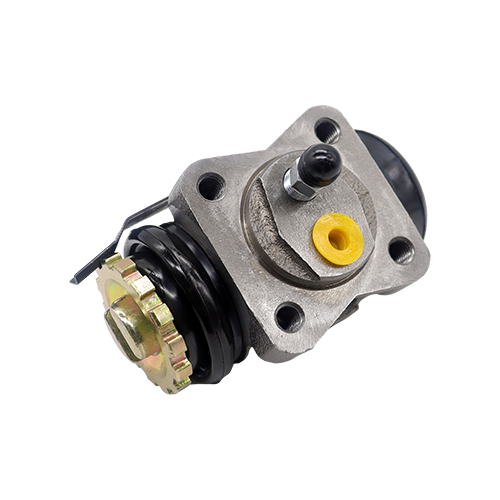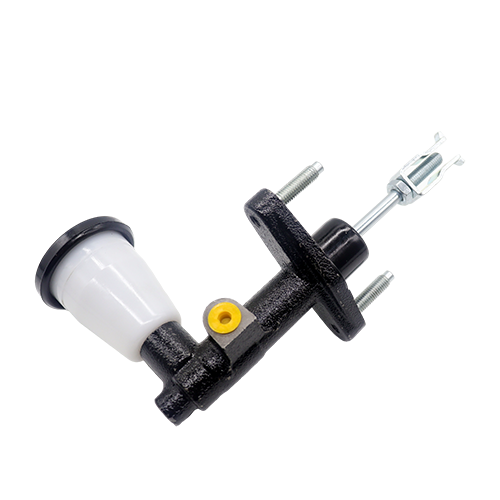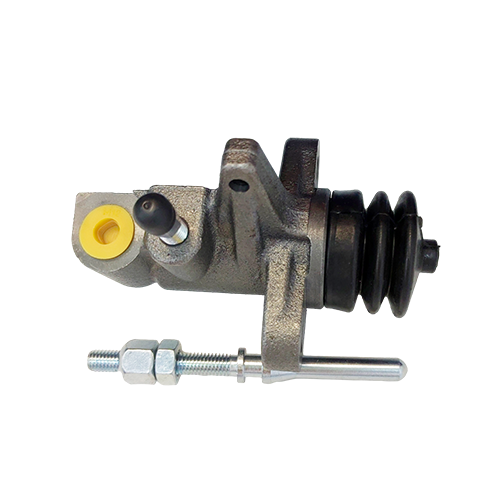
A low quote looks safe at first. Then leakage, returns, and warranty claims appear. I have seen price savings turn into higher business risk.
A brake master cylinder replacement cost estimate should include the part cost, labor cost, vehicle application risk, and failure risk. For importers and distributors, the real cost is total ownership cost, not only the first purchase price.
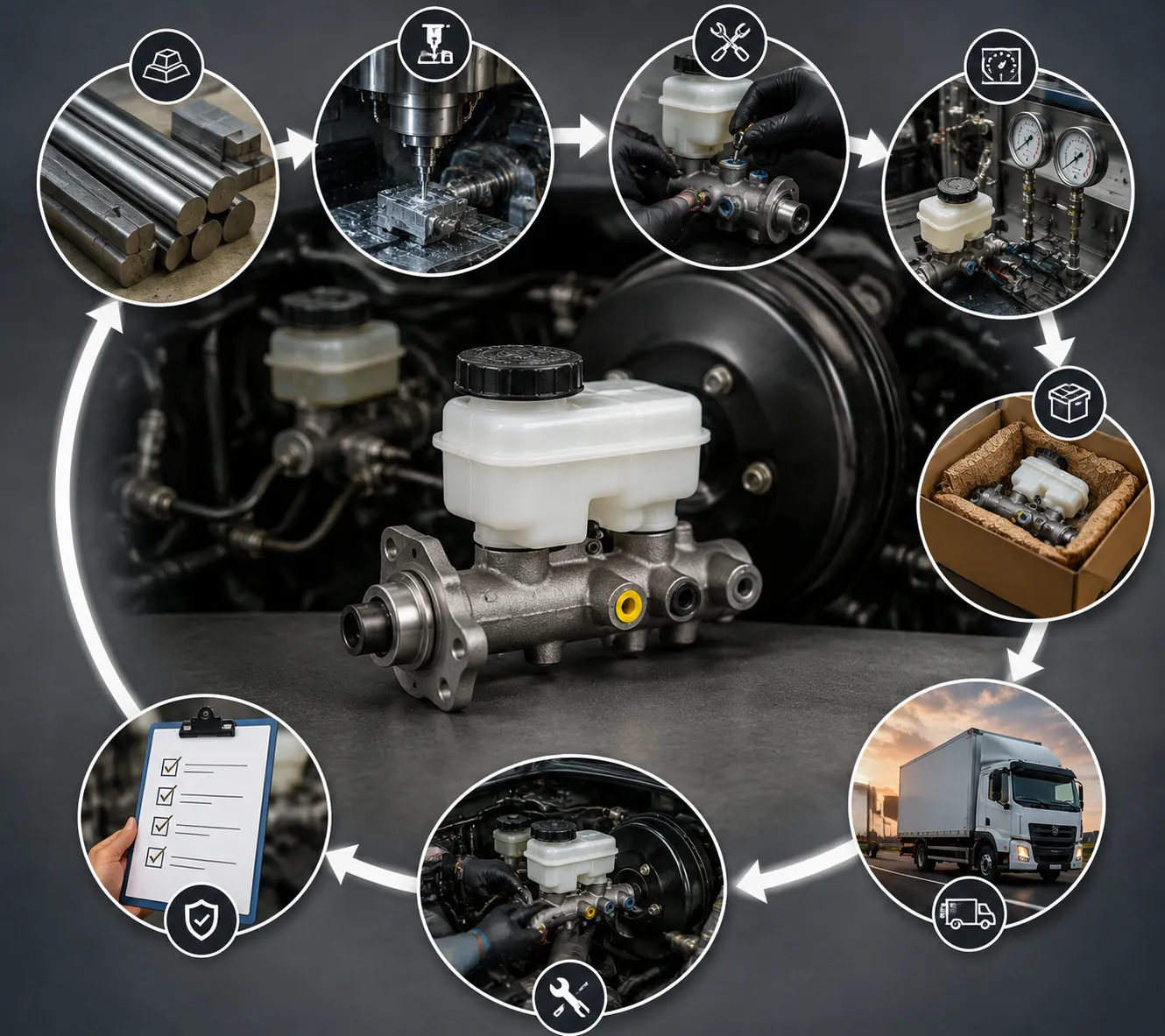
I often receive one direct question from buyers: “What is your price?” I understand why they ask it. Price affects profit, stock planning, and market competition. Yet I also know that this question is too small. A brake master cylinder is a safety part. It works under hydraulic pressure every time the driver brakes.1 If the part fails too early, the buyer does not only lose the part cost. The buyer may lose labor cost, customer trust, and brand reputation. This is why I prefer to discuss replacement cost as a full chain. The chain starts with raw material. It continues through machining, assembly, testing, packaging, shipment, installation, and after-sales service.2 When I look at the cost in this way, the lowest part price is not always the lowest business cost.
What Makes Up the Real Brake Master Cylinder Replacement Cost?
A simple part quote can hide the real cost. I have seen buyers compare prices too fast and miss labor, warranty, and failure risk.
A real replacement cost includes the cylinder price, local labor cost, brake fluid, possible system bleeding, vehicle model differences, and the risk of early failure after installation.
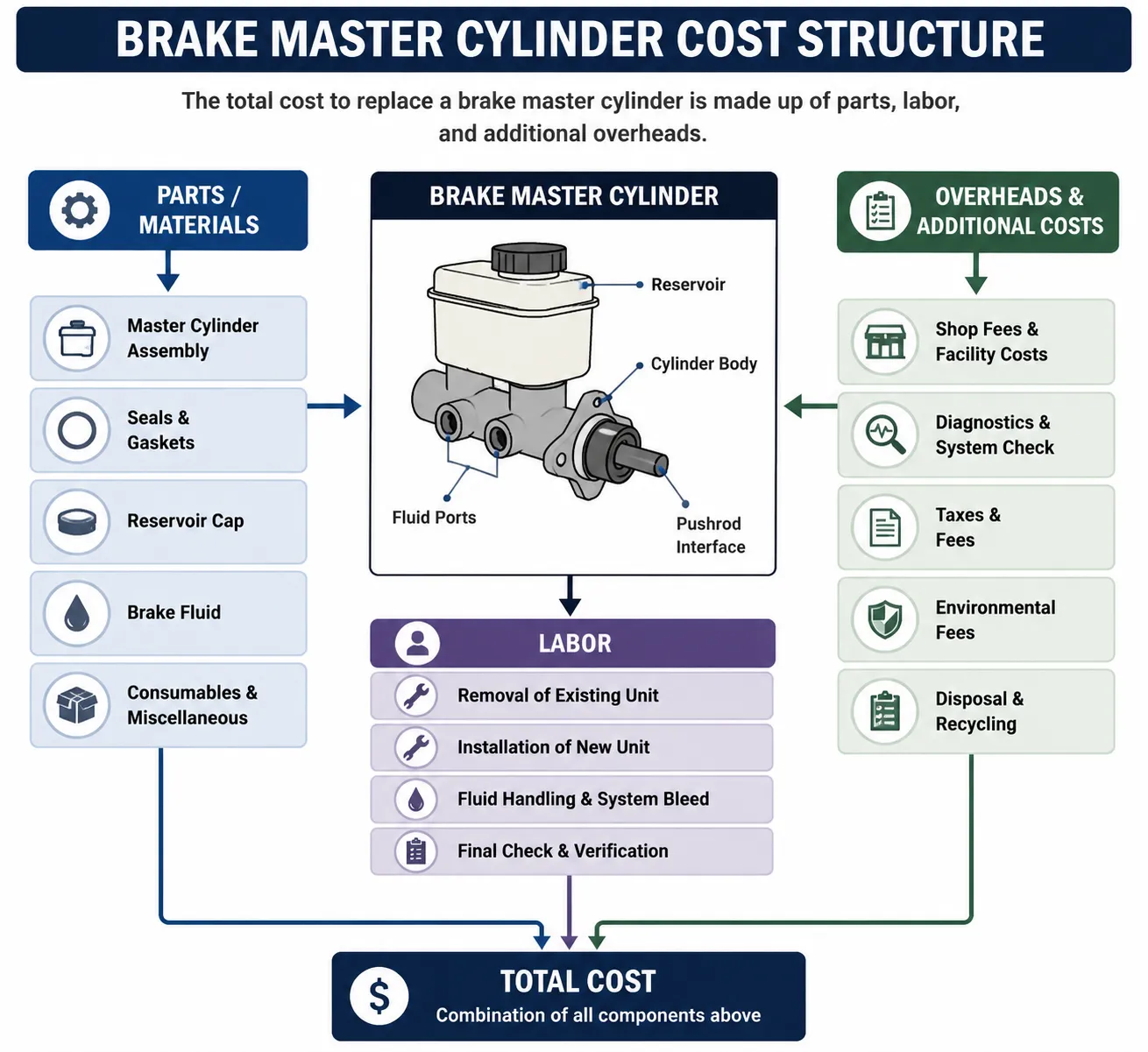
I do not give one fixed replacement cost because it would not be honest. A brake master cylinder for one vehicle model may not cost the same as another. A labor rate in one country may be very different from another. A commercial vehicle may also create more pressure on the brake system than a small passenger car.3 So I look at the full cost structure first.
| Cost Area | What It Includes | Why I Care as a Supplier |
|---|---|---|
| Part cost | Brake master cylinder purchase price | It affects import cost and resale margin |
| Labor cost | Removal, installation, bleeding | It becomes painful if the part fails again |
| Fluid and small parts | Brake fluid, seals, fittings if needed | These small items still affect service cost |
| Vehicle application | Model, year, engine, brake system type | Wrong matching causes returns and complaints |
| Failure risk | Leakage, low pressure, short life | This can damage the buyer’s reputation |
I tell buyers that the part price is only the visible part. The hidden part is the cost of repeating the work. If a poor cylinder leaks after a short time, the customer will not only complain about the product. The customer may ask who pays for the second labor cost. This is where the replacement estimate becomes a business risk estimate. For importers and wholesalers, this risk matters more than a small saving on one piece.
Why Do Brake Master Cylinder Prices Vary So Much?
Two cylinders may look similar on the outside. I have seen big differences inside the material, bore finish, rubber seal quality, and testing level.
Brake master cylinder prices vary because factories use different body materials, rubber compounds, machining accuracy, inspection methods, and testing standards. These choices decide service life and pressure stability.
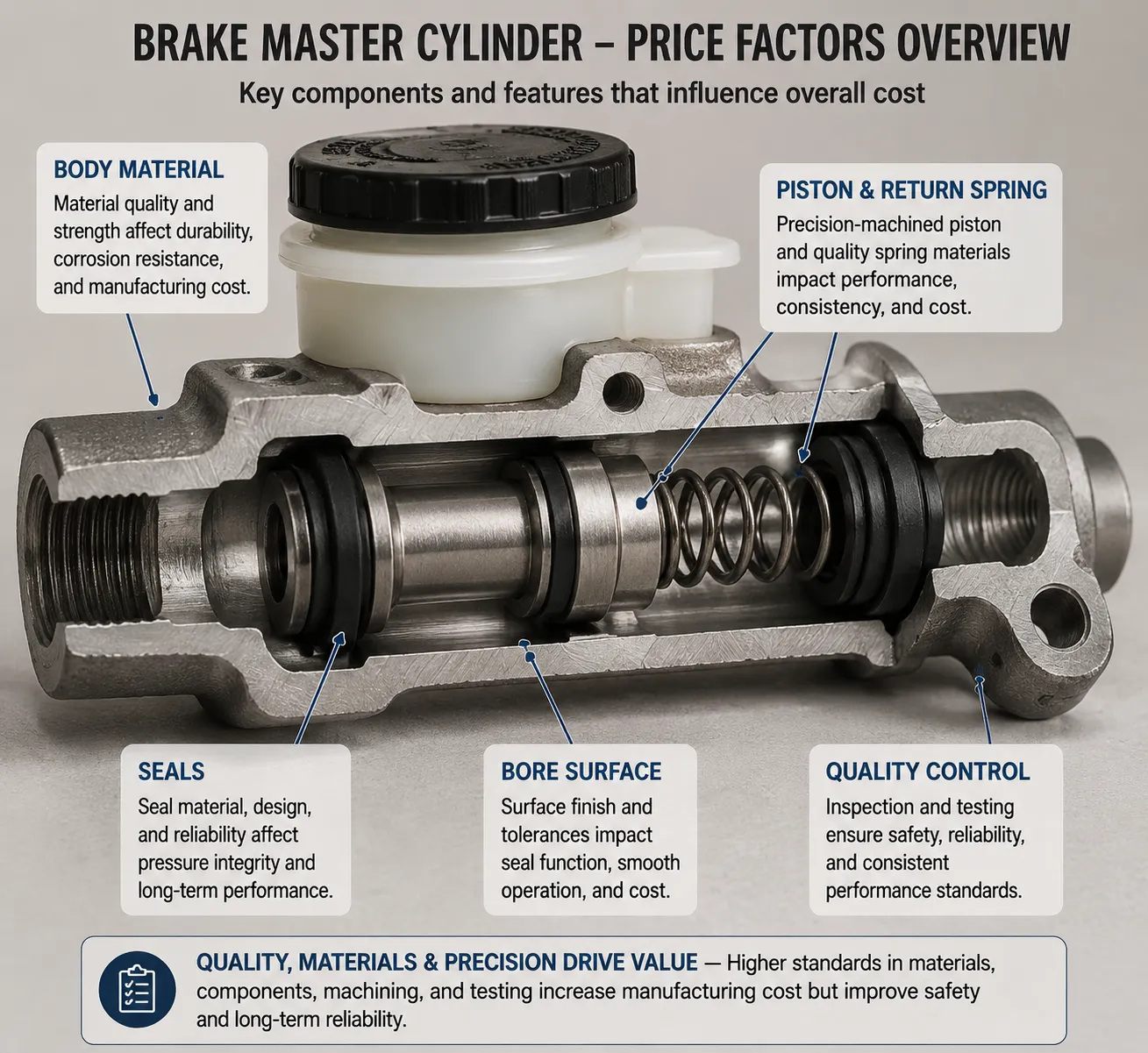
I often explain that a brake master cylinder is not priced only by weight or shape. The real value sits in the parts that the eye cannot judge quickly. The cylinder body may use cast iron or aluminum alloy.4 Each material has its own cost and production control needs. The piston, spring, seal, and bore surface must work together. If one part is weak, the full product becomes weak.
| Price Factor | Low-Cost Risk | Better-Controlled Result |
|---|---|---|
| Body material | Weak structure or unstable surface | Better pressure support and longer use |
| Bore machining | Seal damage and leakage | More stable sealing performance |
| Rubber seal | Swelling, wear, or hardening5 | Better brake fluid resistance |
| Spring quality | Poor return movement | More stable pedal response |
| Testing method | Defects enter the market | Fewer warranty claims |
In my factory work, I pay close attention to CNC machining. The bore dimension and surface finish directly affect sealing.6 A small error can cause fluid leakage or pressure loss. Buyers may not see this problem when they inspect the product in a warehouse. The problem may only appear after months in the market. That is why I do not treat a very low price as a simple advantage. I ask what was removed to reach that price. Sometimes the removed part is better material. Sometimes it is full testing. Sometimes it is process control. These choices decide the long-term replacement cost.
How Does Manufacturing Precision Affect Long-Term Replacement Cost?
A small machining error can become a large market problem. I have learned this from after-sales feedback and internal quality discussions.
Manufacturing precision affects replacement cost because poor dimensions can damage seals, reduce hydraulic pressure, cause leakage, and shorten service life. Accurate machining reduces repeat repair and warranty risk.
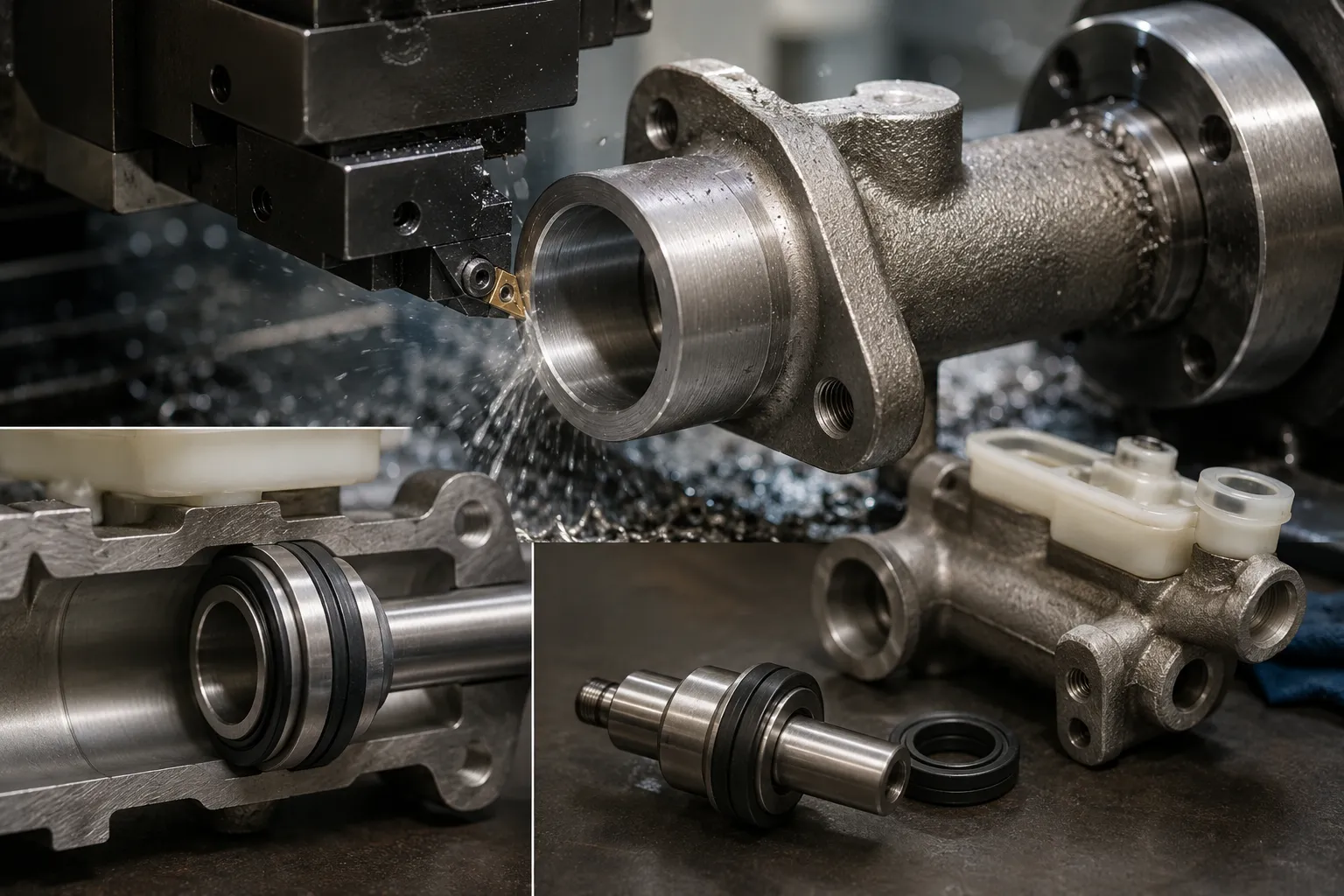
I see the brake master cylinder as a pressure control product. The driver pushes the pedal. The piston moves. The seal must hold pressure. The bore must allow smooth movement. If the fit is not stable, the product cannot perform well for a long time. This is why machining is more than a production step. It is a cost-control step for the buyer.
| Manufacturing Point | What Can Go Wrong | Business Result |
|---|---|---|
| Bore diameter | Seal cannot hold pressure | Customer reports soft brake pedal7 |
| Surface roughness | Seal wears too fast | Leakage and early return |
| Piston fit | Movement is not smooth | Poor braking feel |
| Cleaning process | Dirt remains inside | Internal scratches or blockage |
| Assembly control | Seal twists or spring sits wrong | Product fails after installation |
I do not expect every buyer to measure each bore. That is not practical for importers. Yet I do suggest that buyers ask how the supplier controls these points. I look for CNC machining records, inspection steps, and pressure test results. I also care about 100% finished product inspection. Batch testing can miss single-unit defects.8 In the aftermarket, one failed part can create a complaint that reaches many customers. For a private label brand, one bad claim can hurt future orders. Good precision may not make the product look more beautiful in the box. It makes the product more stable after installation. That stability is where long-term cost is reduced.
What Hidden Costs Come From a Cheap Brake Master Cylinder?
A cheap cylinder can look profitable during purchasing. I have seen the same choice become expensive after leakage and repeat service claims.
Hidden costs can include second labor charges, warranty replacement, brake fluid loss, damage to nearby components9, customer complaints, and loss of brand trust in the market.
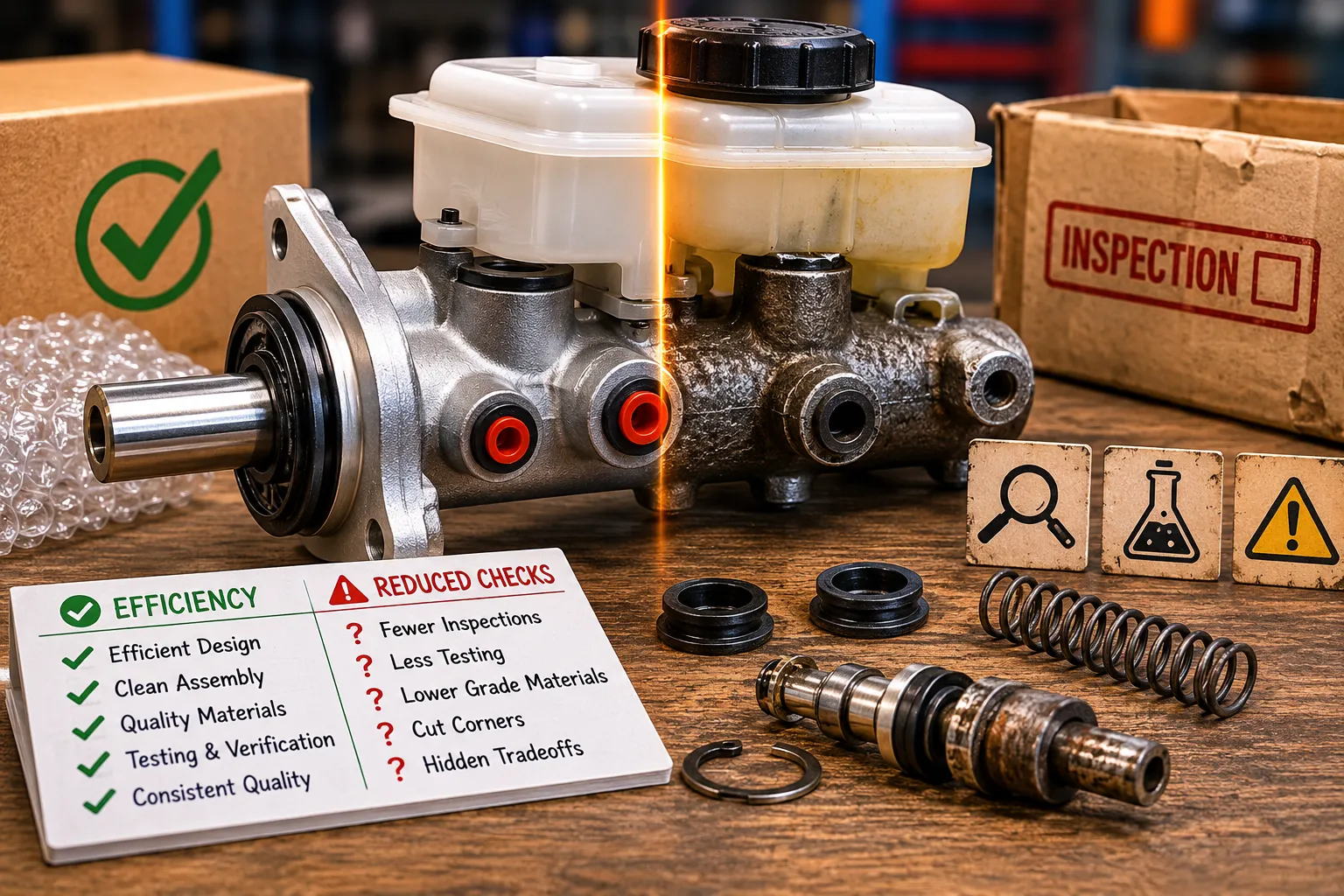
I do not say every low-priced product is bad. I also do not say every high-priced product is good. I say the buyer must know what the price represents. If the price is lower because the factory has strong production efficiency, that is good. If the price is lower because the factory reduced material quality, inspection, or testing, the buyer may be buying future complaints.
| Hidden Cost | How It Appears | Why It Matters |
|---|---|---|
| Repeat labor | Workshop replaces the part again | Someone may demand compensation |
| Warranty stock | Distributor sends a new unit | Inventory and profit are affected |
| Fluid leakage | Brake fluid escapes | Safety risk and customer anger increase |
| Related damage | Booster or nearby parts suffer | Claim value may become higher |
| Brand damage | Dealers lose confidence | Future sales become harder |
I often remind buyers that brake parts are different from many cosmetic parts. A small failure can become a serious safety concern.10 If a master cylinder cannot build pressure, the driver feels it at once. If it leaks, the workshop sees the problem. If the same issue appears several times, dealers may stop trusting the brand. Then the cost is no longer one cylinder. The cost becomes lost shelf space, lost dealer support, and more difficult market entry. For importers in competitive markets, trust is expensive to rebuild. So I prefer to compare products by risk level, not only by unit price. A stable product protects profit better than a product that only looks cheap on the purchase order.
What Should Professional Buyers Ask Before Comparing Prices?
Many buyers ask me for price first. I think they get better answers when they ask about quality control first.
Professional buyers should ask about material sourcing, machining control, rubber seal quality, pressure testing, leakage testing, inspection rate, warranty handling, and application matching before comparing prices.11
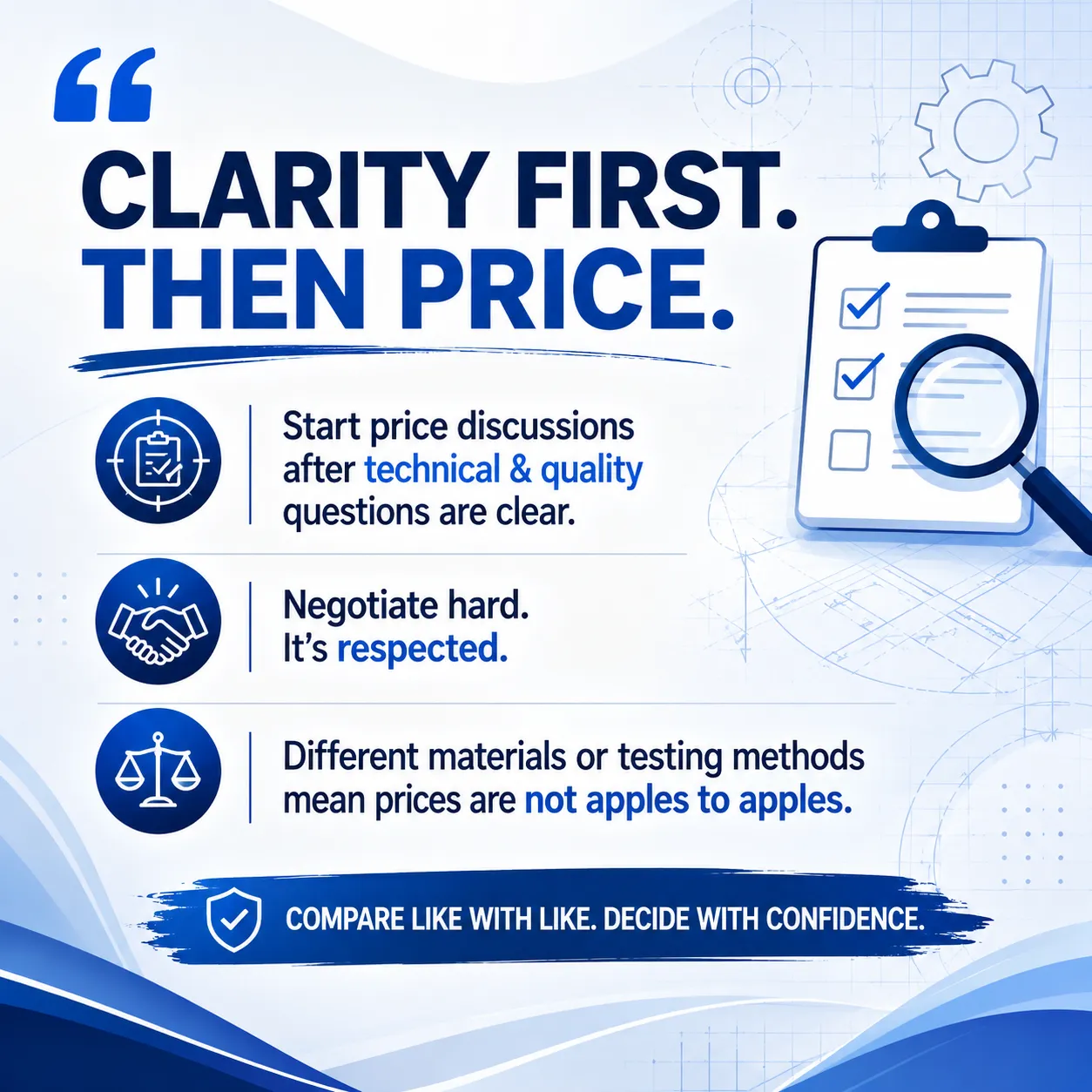
I respect buyers who negotiate hard. Price control is part of their job. Yet I also believe that a professional price discussion should start after the technical and quality questions are clear. If two suppliers use different materials and different testing methods, their prices are not equal objects for comparison.
| Question to Ask | What the Answer Shows | Why It Helps |
|---|---|---|
| What material is used for the body? | Basic strength and process level | It helps judge durability |
| How is the bore machined? | CNC control and precision level | It affects sealing performance |
| What rubber material is used? | Fluid resistance and service life | It affects leakage risk |
| Is each unit pressure tested? | Inspection seriousness | It reduces defective shipments |
| How are complaints handled? | Supplier responsibility | It protects the buyer after sale |
| Can you support private label packaging? | Brand support ability | It helps market development |
| How do you confirm applications? | Catalog and matching control | It reduces wrong-part returns |
I also ask buyers to share their market details. A supplier cannot support well if the vehicle application is unclear. Some markets have Japanese and Korean vehicles as the main demand. Some markets have European or American models. Some buyers need wide coverage. Some buyers need fast-moving references first. A good supplier should help reduce wrong purchases, not only ship boxes. In my experience, the best buyer-supplier talks are practical. We discuss model coverage, samples, inspection, packaging, warranty process, and lead time. Then price becomes clearer. It is no longer a number floating alone. It becomes a number connected with risk, service, and expected product life.
How Can Importers Estimate Replacement Risk Across a Product Line?
One model may pass the first order. A full product line can still create risk if quality control is not stable.
Importers can estimate replacement risk by reviewing supplier process control, inspection records, failure feedback, material consistency, application data accuracy, and after-sales response across all models.
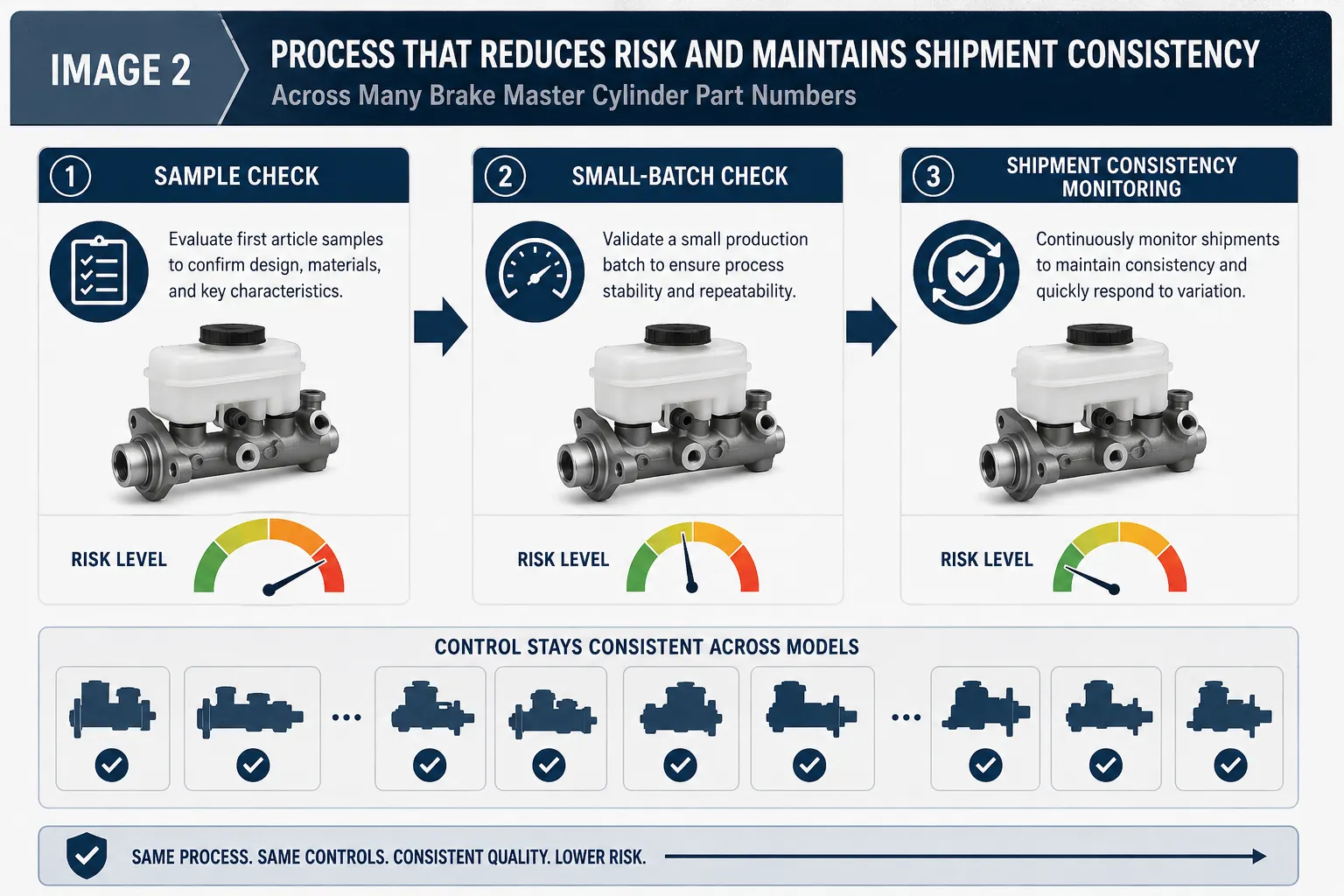
I work with buyers who do not purchase only one brake master cylinder reference. Many importers and distributors need a range of models. This makes risk control harder. A sample may be good. A small batch may be good. The real question is whether the supplier can keep the same control across many part numbers and many shipments.
| Risk Check Area | What I Would Review | What It Reduces |
|---|---|---|
| Product coverage | Main vehicle applications and fast-moving models | Wrong inventory planning |
| Process consistency | Same machining and testing rules across models | Unstable quality |
| Inspection system | Incoming, production, final inspection | Defective goods entering market |
| Packaging control | Label, box, carton, part number accuracy | Warehouse and dealer confusion |
| After-sales data | Repeated failures and complaint types | Repeated market loss |
| Lead time stability | Production plan and capacity | Stock shortage risk |
I believe importers should treat supplier selection like risk management. A cheaper supplier may look attractive for a trial order. Yet the buyer should ask whether the same supplier can support repeat orders, mixed models, private label needs, and complaint handling. If a product line has 50 or 100 references, even a small defect rate can create many field problems. This is why I look at systems. I care about material verification, housing inspection, machining inspection, leakage testing, pressure testing, and final inspection. These steps are not decoration. They protect the buyer’s market. When a distributor builds a brand, the customer does not separate one part number from another. The customer judges the whole brand. Stable quality across the line is the real cost reducer.12
Conclusion
I estimate replacement cost by total risk, not first price. Better material, precise machining, and reliable testing protect safety, profit, and market trust.
"Hydraulic brake - Wikipedia", https://en.wikipedia.org/wiki/Hydraulic_brake. A source can explain that the brake master cylinder is a key component in a hydraulic brake system, converting the mechanical force from the driver's pedal into hydraulic pressure to actuate the brakes, based on Pascal's principle of fluid dynamics. Evidence role: mechanism; source type: encyclopedia. Supports: The claim that a master cylinder works under hydraulic pressure.. ↩
"[PDF] Life-Cycle Cost Analysis Primer - Federal Highway Administration", https://www.fhwa.dot.gov/pavement/lcca/010621.pdf. A source can define the concept of Total Cost of Ownership (TCO), which is a financial estimate to help buyers determine the direct and indirect costs of a product, including acquisition, operation, and downstream costs like warranty and disposal. Evidence role: definition; source type: education. Supports: The claim that cost should be viewed as a full chain beyond the initial purchase price.. ↩
"49 CFR Part 393 Subpart C -- Brakes - eCFR", https://www.ecfr.gov/current/title-49/subtitle-B/chapter-III/subchapter-B/part-393/subpart-C. A source can show that due to their significantly higher gross vehicle weight, commercial vehicles require more robust braking systems capable of generating greater braking force and dissipating more heat compared to passenger cars. Evidence role: general_support; source type: research. Supports: The claim that commercial vehicles generate more pressure or stress on the brake system.. ↩
"Overview of Materials Used for the Basic Elements of Hydraulic ...", https://pmc.ncbi.nlm.nih.gov/articles/PMC7999906/. A source can describe the engineering trade-offs between cast iron and aluminum alloys for automotive components. Cast iron offers high strength and wear resistance, while aluminum provides significant weight savings and better thermal conductivity, with each choice affecting performance and manufacturing cost. Evidence role: general_support; source type: paper. Supports: The claim that cast iron and aluminum alloy are used for master cylinders and have different properties.. ↩
"Will brake fluid eat through rubber? - Quora", https://www.quora.com/Will-brake-fluid-eat-through-rubber. A source can detail the common failure mechanisms for elastomeric seals (like EPDM rubber) in automotive brake systems, which include swelling from fluid absorption, chemical hardening from heat and oxidation, and abrasive wear from movement against the cylinder bore. Evidence role: mechanism; source type: research. Supports: The claim that rubber seals can fail by swelling, wearing, or hardening.. ↩
"Understanding Surface Finish for Optimal Hydraulic Seal Performance", https://www.linkedin.com/pulse/understanding-surface-finish-optimal-hydraulic-ma3pe. A source can explain the engineering principle that the surface finish and dimensional accuracy of a cylinder bore are critical for the function and longevity of hydraulic seals. A rough surface can cause abrasive wear on the seal, while incorrect dimensions can lead to leaks and pressure loss. Evidence role: mechanism; source type: paper. Supports: The claim that bore dimension and surface finish are critical to sealing.. ↩
"What would cause mushy/spongy brake pedal to come and go?", https://www.reddit.com/r/MechanicAdvice/comments/q8vl0y/what_would_cause_mushyspongy_brake_pedal_to_come/. An automotive diagnostic guide can confirm that a 'soft' or 'spongy' brake pedal is a classic symptom of an internal leak within the master cylinder, where hydraulic pressure bypasses the piston seals, often due to wear or imperfections in the cylinder bore. Evidence role: case_reference; source type: education. Supports: The claim that a manufacturing defect can cause a soft brake pedal.. ↩
"6.2.1. What is Acceptance Sampling?", https://www.itl.nist.gov/div898/handbook/pmc/section2/pmc21.htm. A source on quality control can explain that acceptance sampling (batch testing) operates on statistical probabilities and carries an inherent 'consumer's risk' of accepting a lot that contains defective items. For safety-critical components, 100% inspection is often preferred to minimize this risk. Evidence role: definition; source type: paper. Supports: The claim that batch testing can miss defects.. ↩
"What Damages Car Paint: A Definitive Breakdown | UTI", https://www.uti.edu/blog/collision/ruin-car-paint. A source can state that conventional brake fluids (glycol-ether based) are aggressive solvents that can damage vehicle paint, plastic components, and wire insulation on contact, leading to repair costs beyond the failed component itself. Evidence role: mechanism; source type: institution. Supports: The claim that leaking brake fluid can damage other components.. ↩
"Brake Systems - Publication Topic - CrashStats - NHTSA - DOT", https://crashstats.nhtsa.dot.gov/#!/PublicationList/11. A source such as the U.S. Federal Motor Vehicle Safety Standard (FMVSS) 135 specifies stringent performance requirements for vehicle brake systems, including provisions for partial system failure, underscoring that components like the master cylinder are safety-critical. Evidence role: expert_consensus; source type: government. Supports: The claim that master cylinder failure is a serious safety concern.. ↩
"Comprehensive Procurement Guidelines for Vehicular Products - EPA", https://www.epa.gov/smm/comprehensive-procurement-guidelines-vehicular-products. A source on strategic procurement can describe the supplier qualification process, which involves evaluating a potential supplier's quality management systems, process controls, and technical capabilities before price negotiations, especially for critical components. Evidence role: general_support; source type: education. Supports: The claim that buyers should ask detailed quality questions before comparing prices.. ↩
"What Does “Product Quality” Really Mean?", https://sloanreview.mit.edu/article/what-does-product-quality-really-mean/. A source can describe the 'Cost of Poor Quality' (COPQ) framework, which demonstrates that costs associated with defects—such as rework, warranty claims, and lost sales—often far exceed the savings from cutting corners on materials or process control. Therefore, investing in process consistency to ensure stable quality reduces total costs. Evidence role: general_support; source type: research. Supports: The claim that stable quality is a cost reducer.. ↩