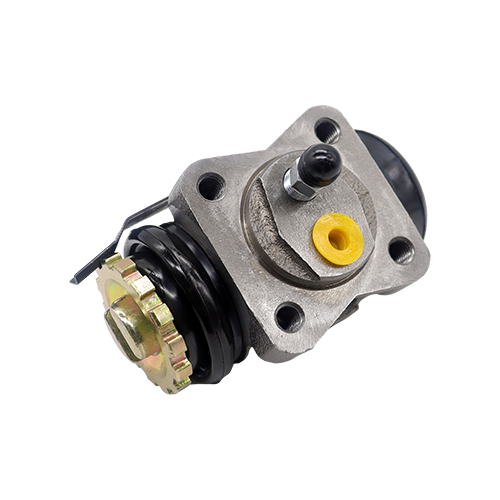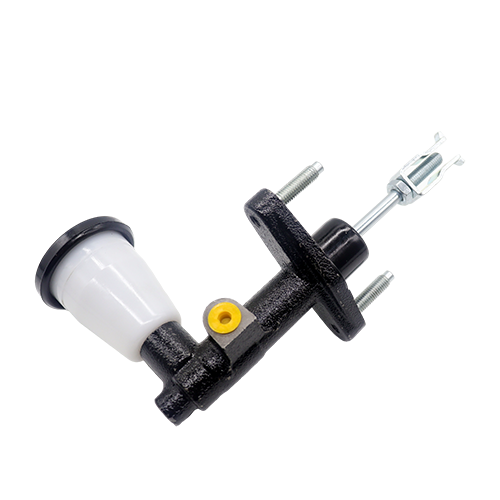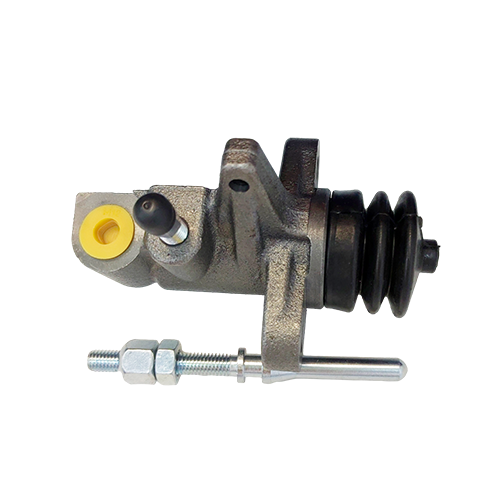
Brake failure is not always dramatic. Sometimes it starts with a soft pedal, a slow leak, or a vehicle that just doesn't stop the way it should. Nine times out of ten, when I trace that problem back through a drum brake system, I find the wheel cylinder.1
A wheel cylinder is a small hydraulic component in a drum brake system. It receives hydraulic pressure from the brake master cylinder and pushes the brake shoes outward against the drum to slow or stop the vehicle.2 When it fails, braking force drops — and that is a serious safety problem.3
I have been working in brake component manufacturing at GDST since 2005. Our factory has produced tens of millions of wheel cylinders for markets across Southeast Asia, South America, the Middle East, and Africa. I have seen how these parts perform in the field, and I have seen exactly where and why they fail. This article shares what I know from the factory floor — not from a textbook.
How Does a Wheel Cylinder Actually Work?
Most people understand the basic idea: press the brake pedal, the car stops. But most people don't think about the chain of events that happens between those two actions.
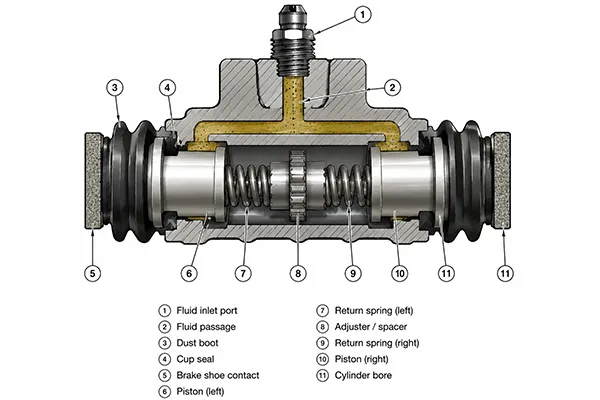
When you press the brake pedal, the master cylinder builds hydraulic pressure and sends it through the brake lines. The wheel cylinder receives that pressure. The pressure pushes two pistons outward from both ends of the cylinder body. Those pistons push the brake shoes against the inside of the brake drum. Friction stops the wheel.
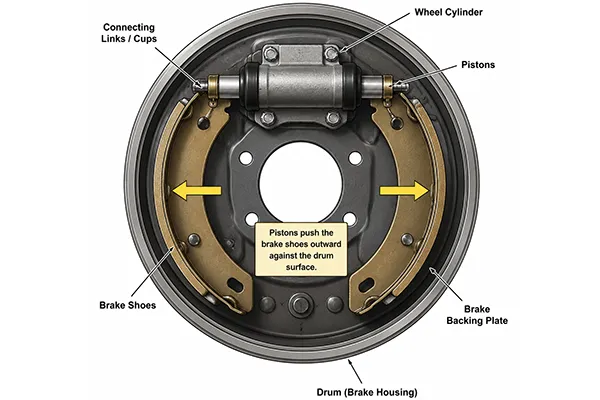
The wheel cylinder sits at the top of the drum brake assembly. It is bolted directly to the brake backing plate. Two brake shoes connect to the cylinder's pistons through small metal links or cups.
The design looks simple. A cylinder body, two pistons, two rubber seals, a return spring, and a bleeder screw. That is the whole part.
But simple design does not mean simple manufacturing. I tell every new importer we work with the same thing: the difficulty of a wheel cylinder is not in its structure. The difficulty is in the precision needed to make that structure work reliably under real-world conditions.
Here is what I mean. The wheel cylinder operates under hydraulic pressure every single time the driver touches the brake pedal. Over the life of a vehicle, that can mean hundreds of thousands of cycles.4 Each cycle puts stress on the seals and the bore surface. If any part of that internal assembly is not made to a tight tolerance, the part will start to leak — and leaking brake fluid means reduced braking pressure.
Inside the Wheel Cylinder: What Each Part Does
| Component | Material | Function |
|---|---|---|
| Cylinder Body | Cast Iron or Aluminum Alloy | Houses all internal parts, withstands pressure |
| Piston | Aluminum or Steel | Translates hydraulic pressure into outward force |
| Rubber Seal (Cup) | EPDM Rubber | Prevents fluid from leaking past the piston |
| Return Spring | 65Mn Spring Steel | Retracts pistons when brake pedal is released |
| Bleeder Screw | Carbon Steel | Allows air to be purged from the hydraulic system |
| Dust Boot | Rubber | Keeps dirt and moisture out of the cylinder opening |
Each component plays a specific role. But from a manufacturing standpoint, the cylinder body and the rubber seals are the two parts that determine whether a wheel cylinder lasts or fails early.
What Materials Are Used, and Why Does It Matter?
When importers first contact us at GDST, many ask about price. The second question is usually about material. This is the right question to ask.
Wheel cylinder bodies are made from either gray cast iron (such as HT200) or aluminum alloy (such as ZL111).5 Cast iron offers higher strength and better wear resistance. Aluminum alloy is lighter and resists corrosion better.6 The choice depends on the vehicle type and the market's climate conditions.
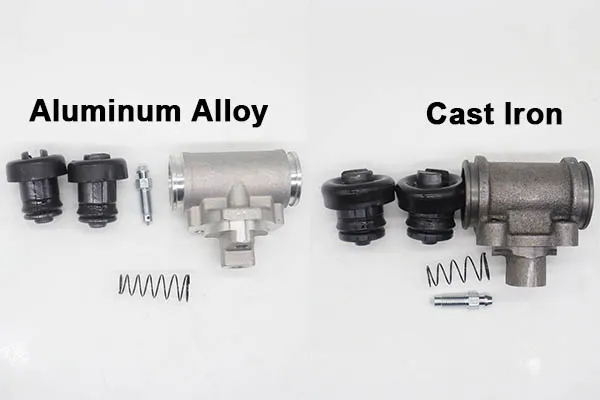
I want to go deeper here because this is where I see importers make sourcing mistakes.
On the surface, two wheel cylinders made from different grades of cast iron can look identical. They have the same dimensions. They fit the same vehicle. But their internal quality is completely different.
HT200 gray cast iron is the industry standard for good reason.7 It has a consistent grain structure. It machines cleanly. It holds its shape under pressure and heat. Lower-grade iron, which some suppliers use to cut costs, can have internal voids or inconsistent hardness. When you machine a bore into that material, the surface finish is uneven. An uneven bore surface destroys rubber seals faster.
This is why at GDST, we do incoming material inspection on every batch of raw castings. We check material composition, not just dimensions. A casting can pass a visual inspection and still be made from the wrong grade of iron. You won't find that out until the part starts failing in the field.
For aluminum alloy cylinders, ZL111 is our standard choice. It has good casting properties and machines to a fine surface finish. Some suppliers substitute cheaper aluminum alloys that are harder to machine and don't hold tight tolerances as well. Again, this shows up later as seal wear and leaks — not during initial testing.
How to Evaluate Wheel Cylinder Material Quality as a Buyer
| What to Ask the Supplier | Why It Matters |
|---|---|
| What grade of cast iron or aluminum alloy do you use? | Grade determines machinability and durability |
| Do you conduct incoming material composition inspection? | Confirms the stated material is actually used |
| Can you provide material test reports? | Third-party verification adds accountability |
| What is your bore surface roughness specification? | Surface finish directly affects seal life |
The answers to these questions tell you more about a supplier's quality level than any catalog or price list ever will.
Why Do Wheel Cylinders Fail?
In our years of producing wheel cylinders and talking to importers dealing with field returns, I have seen the same failure patterns come up again and again. The causes are almost never random.
Wheel cylinder failures fall into three main categories: fluid leakage, insufficient braking pressure, and early wear-out. Each failure type has a specific manufacturing root cause. Leakage usually points to poor rubber seals or a rough bore surface. Insufficient pressure usually points to seal wear or piston damage. Early failure usually points to substandard materials.
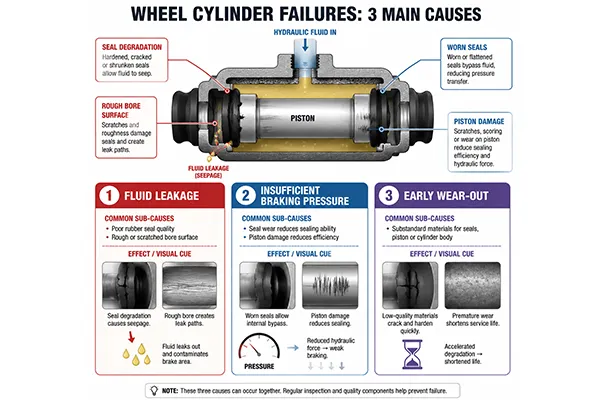
Let me break each one down from what I see on the production side.
Fluid Leakage
This is the most common failure mode we hear about from distributors. Brake fluid appears on the inside of the wheel, behind the drum. The driver notices a soft pedal or the vehicle pulls to one side when braking.
The cause is almost always one of two things: a damaged rubber seal, or a bore surface that was not machined to the right finish.
The rubber seal sits inside the cylinder and presses against the bore wall. Its job is to hold hydraulic pressure while allowing the piston to move. If the bore surface is rough — meaning the Ra (surface roughness) value is too high — the seal wears down faster than it should.8 We see this with cylinders that come back from the field after only 20,000 or 30,000 kilometers. The seal looks abraded, not cracked. That tells us the bore was rough.
We use CNC machining centers for our cylinder bores. CNC gives us tight control over bore diameter and surface finish. After machining, we inspect surface roughness with dedicated testing equipment. A smooth bore is not a luxury. It is a requirement for the seal to do its job.
Insufficient Braking Pressure
This failure is more dangerous because it is less visible. The car brakes, but not strongly enough. The driver might not notice until an emergency stop.
This usually points to seal wear that allows pressure to bleed past the piston, or a piston that is damaged or undersized. In both cases, the hydraulic pressure that should be pushing the brake shoes outward is escaping instead.
From a manufacturing standpoint, this comes back to dimensional accuracy. The piston must fit the bore with the right clearance — tight enough for the seal to hold pressure, loose enough for the piston to move freely. This is a precision requirement that only consistent CNC machining can reliably deliver.
Early Wear-Out and Reduced Service Life
A wheel cylinder should last well over one million operating cycles under normal conditions.9 When we hear about parts failing at a fraction of that, the root cause is almost always material quality.
Inferior base materials, wrong rubber compounds in the seals, or wrong spring steel in the return spring. Any one of these will shorten the life of the part. This is why we specify EPDM rubber for our seals10 and 65Mn spring steel for our return springs.11 These are not the cheapest options. They are the right options for long service life.
Wheel Cylinder Failure Root Cause Summary
| Failure Symptom | Most Likely Root Cause | Manufacturing Control Point |
|---|---|---|
| Fluid leak at cylinder | Rough bore surface or damaged seal | CNC bore machining, EPDM seal quality |
| Soft brake pedal | Pressure loss past worn seal | Piston-to-bore clearance control |
| Vehicle pulls when braking | Uneven pressure output between sides | Assembly consistency, 100% pressure testing |
| Early seal failure | Wrong rubber compound or rough bore | Material specification, surface finish control |
| Part failure before 50,000 km | Substandard base material | Incoming material inspection |
How Do You Know If a Wheel Cylinder Is Well Made?
This is the question behind the question for most importers I talk to. They don't just want to know what a wheel cylinder is. They want to know how to tell a good one from a bad one before it goes into their customer's vehicle.
A well-made wheel cylinder passes 100% hydraulic pressure testing and 100% leakage testing before it leaves the factory.12 It is made from verified-grade materials, machined to a precise bore finish, and assembled under controlled conditions. The best proof of quality is a supplier's documented testing process, not their catalog claims.
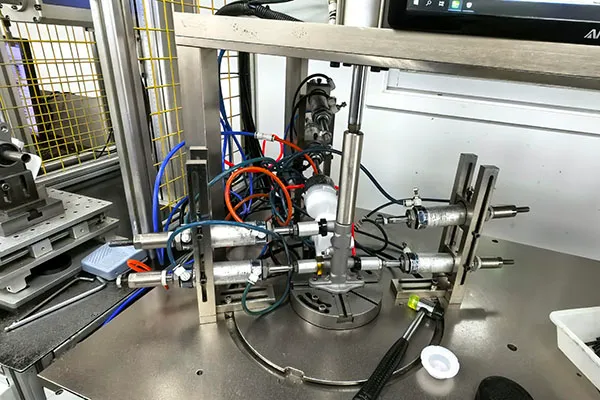
When I walk a new customer through our factory, I always stop at three points. These are the three things I believe separate a reliable wheel cylinder from a field failure waiting to happen.
The first stop is the CNC machining area. I show them how we machine every cylinder bore to a controlled diameter and surface finish specification. I explain that this is the most critical step in the entire process. Every other quality decision depends on getting this right. A rough bore cannot be fixed later. It can only be covered up — and eventually, it shows up as a warranty return.
The second stop is incoming material inspection. I show them that we do not simply accept castings from our suppliers based on their word. We verify material composition. We check dimensional accuracy on incoming castings before they enter production. This step costs time and money. But it is the only way to guarantee that what we say is inside the part is actually inside the part.
The third stop is the final testing station. Every single finished wheel cylinder is tested for hydraulic pressure performance and leakage before it is packaged. Not a sample. Every unit. I tell importers: if your current supplier cannot tell you that they test 100% of finished product, ask them what percentage they do test. The answer will tell you a great deal about their quality commitment.
Beyond these three points, there are other details worth asking about when evaluating a wheel cylinder supplier.
What to Look for When Sourcing Wheel Cylinders
| Evaluation Area | What to Ask | What a Good Answer Looks Like |
|---|---|---|
| Material | What grade of iron or aluminum do you use? | Specific grade cited (e.g., HT200, ZL111), with inspection records |
| Machining | How do you control bore diameter and surface finish? | CNC machining with documented tolerance specs |
| Seals | What rubber compound do you use for the seals? | EPDM specified, matched to brake fluid compatibility |
| Testing | Do you test 100% of finished product? | Yes, with hydraulic pressure and leakage test for every unit |
| Certification | Are you ISO 9001 certified? | Yes, with audit availability for new customers |
| Returns | What is your warranty and returns process? | Clear responsibility policy, fast response |
A supplier who can answer all of these questions clearly and specifically is a supplier who understands their own manufacturing process. A supplier who gives vague answers or deflects these questions is a supplier whose quality consistency you should question.
Conclusion
A wheel cylinder is a small part that carries serious responsibility. Its quality comes down to material grade, bore precision, and verified testing — and the right supplier can answer all three.
"[PDF] Experimental Study of Automotive Brake System Temperatures - wsdot", https://www.wsdot.wa.gov/research/reports/fullreports/434.1.pdf. Studies on automotive brake system reliability can provide statistical data on the most common points of failure within drum brake assemblies, contextualizing the role of wheel cylinder failure in overall system performance. Evidence role: statistic; source type: research. Supports: The source should provide data on the frequency of wheel cylinder failure relative to other drum brake components like shoes, springs, or the drum itself.. Scope note: The source may provide general industry statistics which might differ from the specific experience of a single mechanic or manufacturer. ↩
"Wheel cylinder", https://en.wikipedia.org/wiki/Wheel_cylinder. Automotive engineering encyclopedias and technical manuals define the wheel cylinder as the component in a drum brake system responsible for converting hydraulic pressure from the master cylinder into mechanical force to actuate the brake shoes. Evidence role: definition; source type: encyclopedia. Supports: The source should define a wheel cylinder and explain its function within a hydraulic drum brake system.. ↩
"Brake Systems - Publication Topic - CrashStats - NHTSA - DOT", https://crashstats.nhtsa.dot.gov/#!/PublicationList/11. Government transportation safety agencies, such as the National Highway Traffic Safety Administration (NHTSA), classify failures in the hydraulic brake system that lead to reduced braking force as critical safety defects that can increase the risk of a crash. Evidence role: general_support; source type: government. Supports: The source should confirm that a loss of hydraulic pressure due to component failure, such as in a wheel cylinder, constitutes a significant vehicle safety risk.. ↩
"49 CFR 571.135 -- Standard No. 135; Light vehicle brake systems.", https://www.ecfr.gov/current/title-49/subtitle-B/chapter-V/part-571/subpart-B/section-571.135. Automotive engineering research and durability testing standards estimate the number of braking cycles a component may experience over a vehicle's service life, often numbering in the hundreds of thousands to over a million, depending on driving conditions and vehicle use. Evidence role: statistic; source type: paper. Supports: The source should provide data or analysis on the typical number of brake applications over a vehicle's lifespan.. Scope note: The exact number of cycles can vary significantly based on factors like urban vs. highway driving. ↩
"Wheel cylinder - Wikipedia", https://en.wikipedia.org/wiki/Wheel_cylinder. Engineering texts and materials science resources for automotive applications confirm that gray cast iron and aluminum alloys are the predominant materials used for wheel cylinder housings, chosen for their respective properties of strength, wear resistance, and weight. Evidence role: general_support; source type: education. Supports: The source should confirm that cast iron and aluminum alloys are the primary materials used for manufacturing wheel cylinder bodies.. ↩
"6061-T6 Aluminum vs. Grey Cast Iron - MakeItFrom.com", https://www.makeitfrom.com/compare/6061-T6-Aluminum/Grey-Cast-Iron. Materials science literature compares the properties of gray cast iron and aluminum alloys, noting cast iron's superior compressive strength and wear resistance, while aluminum alloys offer advantages in weight reduction and resistance to atmospheric corrosion. Evidence role: mechanism; source type: paper. Supports: The source should compare the material properties of gray cast iron and aluminum alloys, specifically regarding strength, wear resistance, weight, and corrosion resistance.. ↩
"Cast iron - Wikipedia", https://en.wikipedia.org/wiki/Cast_iron. International standards, such as ISO 185 or national equivalents like GB/T 9439, define grades of gray cast iron like HT200, which are commonly specified for automotive components requiring good machinability and moderate strength, including brake parts. Evidence role: general_support; source type: institution. Supports: The source should show that HT200 (or its international equivalent, e.g., ISO 185 Grade 200) is a widely used and specified material for components like brake parts.. Scope note: While widely used, it may be one of several common standards rather than the sole industry standard. ↩
"Experimental Comparison of Elastomeric Materials for Hydraulic ...", https://pmc.ncbi.nlm.nih.gov/articles/PMC12694298/. Research in tribology and fluid power systems demonstrates that an excessively rough cylinder bore surface (high Ra value) acts as an abrasive against elastomeric seals, accelerating wear and leading to premature leakage. Evidence role: mechanism; source type: paper. Supports: The source should explain the mechanical relationship between the surface roughness (Ra) of a cylinder bore and the wear rate of an elastomeric (rubber) seal.. ↩
"Federal Motor Vehicle Safety Standards-Motor Vehicle Brake Fluids", https://www.federalregister.gov/documents/2004/11/19/04-25446/federal-motor-vehicle-safety-standards-motor-vehicle-brake-fluids. Automotive industry standards and testing protocols, such as those developed by SAE International, often specify durability tests for hydraulic brake components that involve hundreds of thousands or millions of pressure cycles to ensure long-term reliability. Evidence role: general_support; source type: institution. Supports: The source should describe durability testing standards or expectations for hydraulic brake components, including lifecycle test requirements.. Scope note: The specific number of cycles can vary based on the standard and the intended vehicle application (e.g., passenger car vs. heavy truck). ↩
"Rubber Compounds and Fluid Compatibility", https://www.musclecarresearch.com/content/rubber-compounds-and-fluid-compatibility. Material selection guides for the automotive industry specify EPDM rubber for seals and hoses in conventional braking systems due to its excellent resistance to swelling and degradation when in contact with glycol-ether based brake fluids. Evidence role: mechanism; source type: research. Supports: The source should confirm that EPDM (Ethylene Propylene Diene Monomer) rubber is recommended for use in brake systems due to its chemical resistance to glycol-based brake fluids (DOT 3, 4, 5.1).. ↩
"65Mn Spring Steel - News-Gnee Corten Steel", https://www.cortensteels.com/news/65mn-spring-steel-60690615.html. Engineering material databases identify medium-to-high carbon steels like 65Mn (or its international equivalents such as AISI 1065) as common choices for manufacturing springs, valued for their high tensile strength and ability to return to their original shape after deformation. Evidence role: general_support; source type: education. Supports: The source should describe the properties of 65Mn steel (or its equivalents like AISI 1065) and its common applications.. ↩
"Brake Pad Certifications Explained: ECE R90, IATF 16949, AMECA ...", https://tuobapro.com/brake-pad-certifications/. Automotive quality management standards, such as IATF 16949, emphasize defect prevention and require stringent process controls for safety-critical components, often including 100% end-of-line functional testing, such as pressure and leak tests for hydraulic parts. Evidence role: expert_consensus; source type: institution. Supports: The source should discuss quality control standards in the automotive industry, particularly for safety-critical components, and whether 100% end-of-line testing is a common requirement.. Scope note: The standard may not explicitly mandate 100% testing for all components, but it requires processes to ensure all products meet specifications, for which 100% testing is a common method for critical parts. ↩